01 Intellectual Property (IP)
SUMMARY
Intellectual Property (IP) refers to creations of the human mind. It protects valuable ideas, inventions, creative works, and confidential business information from unauthorized use.
Definition
Intellectual Property (IP):
Creations resulting from human creativity and intellectual effort that have commercial or legal value.
Unlike physical property, IP is intangible (non-physical) but can still be owned, protected, licensed, sold, or transferred.
What Intellectual Property Includes
- Original Ideas (when legally protectable)
- Research Results
- Critical Business Information
- Books, Articles & Publications
- Music & Songs
- Artwork & Designs
- Software & Source Code
- Inventions
- Brand Names & Logos
- Trade Secrets & Know-how
Intellectual Property vs Real Property
| Intellectual Property (IP) | Real Property |
|---|---|
| Intangible (cannot be physically touched) | Tangible (physical assets) |
| Created through human creativity | Exists as physical property |
| Examples: Software, patents, trademarks | Examples: Land, buildings, houses |
| Protected by IP laws | Protected by property laws |
| Litera |
Key Characteristics
- Created through human creative labour
- Has economic and commercial value
- Can be legally protected
- Can be licensed, sold, or transferred
- Gives the owner exclusive rights for a certain period
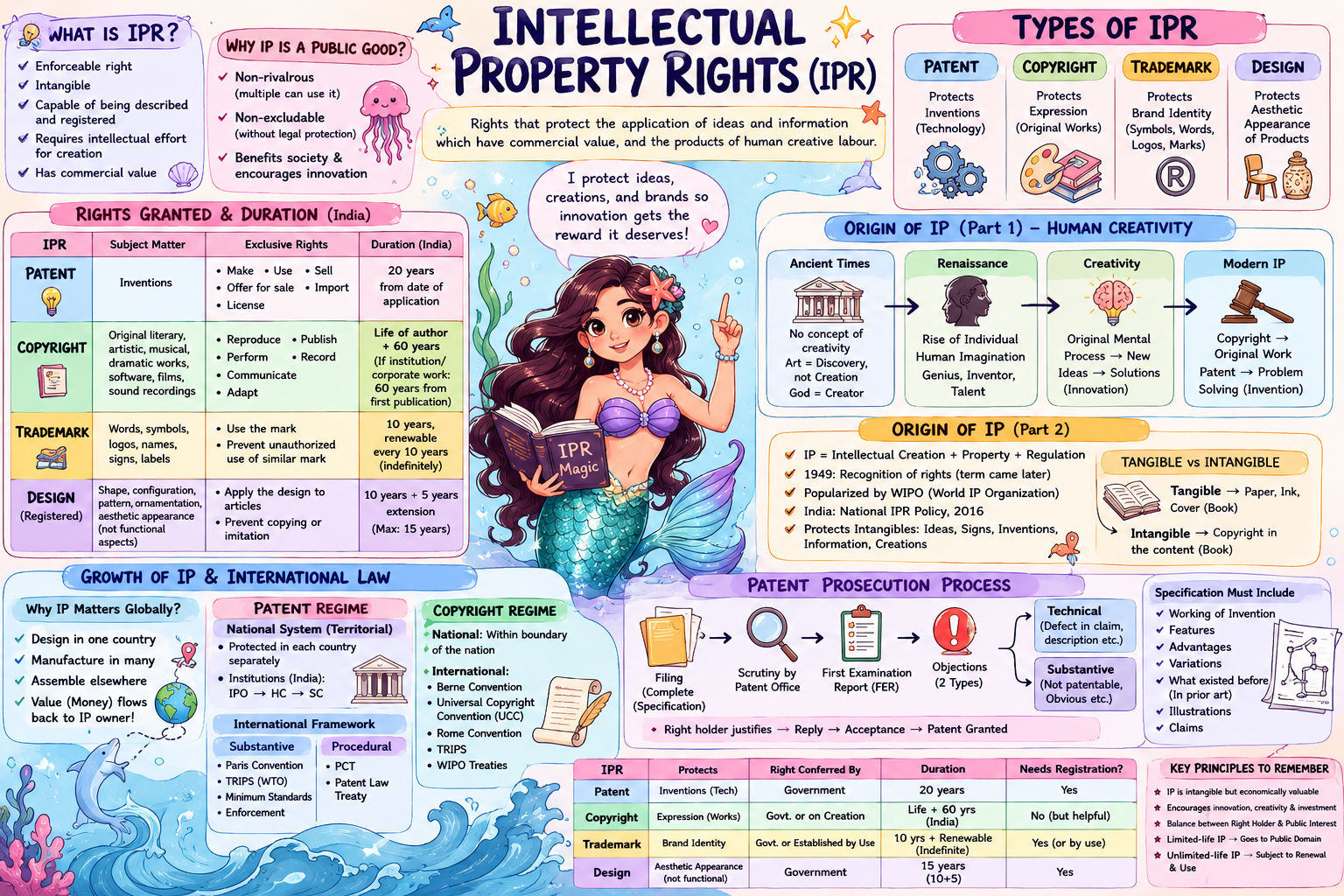
Types of Intellectual Property
- Patent → Protects inventions
- Copyright → Protects literary, artistic, and software works
- Trademark → Protects brand names, logos, and symbols
- Trade Secret → Protects confidential business information
- Industrial Design → Protects the appearance of products
- Geographical Indication (GI) → Protects products linked to a specific region
Why IP is Different
A house can only belong to one owner at a location, but an idea can be copied infinitely. IP laws create legal boundaries around these intangible creations, giving creators exclusive rights and encouraging innovation.
One-Line Revision
Intellectual Property is an intangible asset created through human creativity that is legally protected to give its owner exclusive rights.
02 Intellectual Property Rights (IPR)
SUMMARY
Intellectual Property Rights (IPR) are legal rights granted to creators and owners of Intellectual Property (IP). They give the owner exclusive control over the use of their creations and provide legal remedies if those rights are violated.
Meaning of “Right”
A right is something that is recognized and protected by law.
A right gives a person the legal authority to:
- Perform certain acts.
- Prevent others from performing certain acts without permission.
IMPORTANT
A right exists only when it is recognized by law. Simply claiming something as a right does not make it legally enforceable.
Two Meanings of “Right”
Right as a Liberty
A person has the freedom to perform a particular act.
Example:
- Writing a book
- Creating software
- Painting artwork
Here, the law allows the person to perform these acts.
Right as a License / Permission
A right may arise because someone has been granted legal permission to perform an act.
Example:
- Software license
- Patent license
- Copyright license
The license holder can legally use the IP under the agreed terms.
👤 Human Rights vs Intellectual Property Rights
| Human Rights | Intellectual Property Rights |
|---|---|
| Inherent (exist by virtue of being human) | Created and recognized by law |
| Apply to every individual | Apply only to the IP owner or authorized persons |
| Universal rights | Exclusive legal rights |
NOTE
Human rights are inherent, whereas IPR exists only because the law grants and protects it.
Exclusive Rights
Most Intellectual Property Rights are exclusive rights.
This means the owner can:
- Use the Intellectual Property
- Sell it
- License it
- Transfer ownership
- Stop others from using it without consent
TIP
Exclusive = Only the owner decides who can use it.
Intellectual Property Rights Arise From
IPR protects different forms of Intellectual Property, such as:
- Copyright
- Patent
- Trademark
- Industrial Design
- Trade Secret
- Geographical Indication (GI)
Violation of IPR
Using protected Intellectual Property without the owner’s permission is called Infringement.
Examples:
- Copying copyrighted software
- Selling a patented invention without permission
- Using a registered trademark without authorization
WARNING
Violation of Intellectual Property Rights = Infringement
The owner can seek legal remedies through the courts.
Patent Rights
A Patent gives the inventor the exclusive right to:
- Make the invention, Use the invention, Sell the invention, Import the invention, License the invention to others
Anyone performing these acts without the patent owner’s permission may be committing patent infringement.
Quick Comparison
| Intellectual Property (IP) | Intellectual Property Rights (IPR) |
|---|---|
| The creation or invention | The legal protection for that creation |
| Intangible asset | Legal entitlement |
| Created through human creativity | Granted and enforced by law |
| Example: Software, invention | Example: Copyright, Patent |
IP = The Creation 🧠 IPR = The Legal Shield 🛡️
Remember:
No Legal Protection → Only IP
Legal Protection Granted → IP + IPR
03 What is property in IPR?
SUMMARY
Property refers to something that can be owned, controlled, used, transferred, and protected by law. In IPR, the concept of property is extended from physical assets to intangible creations of the human mind.
NOTE
Property is a form of legal regulation that defines who owns an asset, who can use it, and under what conditions.
Types of Property
Property is broadly classified into two types:
Public Property
Property that is held in common and is available for public use.
Characteristics
- Owned by the government or society
- Used for the benefit of the public
- Individuals generally cannot claim exclusive ownership
Private Property
Property that is owned by an individual or a private organization.
Characteristics
- Has a specific owner
- The owner has exclusive rights
- Others need the owner’s permission to use it
🌍 Real (Physical) Property
Real property refers to tangible physical assets, such as land and buildings.
Characteristics
- Has physical boundaries
- Boundaries can be clearly identified and measured
- Ownership can be determined through legal records
- Others can be excluded from entering or using it without permission
IMPORTANT
The owner of land and its boundaries can be clearly identified, making ownership easy to establish.
Property in IPR
Unlike real property:
- Intellectual Property is intangible
- It has no physical boundaries
- Its “boundaries” are defined by law, not by fences or walls
Examples:
- A patent protects an invention.
- A copyright protects a book or software.
- A trademark protects a brand name or logo.
TIP
Real Property → Protected by physical boundaries
Intellectual Property → Protected by legal boundaries
One-Line Revision
Real property has physical boundaries, while Intellectual Property has legal boundaries created and protected by law.
04 Meaning of Intellectual in IPR
SUMMARY
Intellectual refers to creations that originate from the human intellect the ability to think, reason, understand, imagine, and create.
Human Intellect
Intellect is the human ability to:
- Think logically
- Understand concepts and ideas
- Reason and solve problems
- Imagine and create new things
- Apply knowledge and innovation
Characteristics of Intellectual Creations
- Arise from human creativity and intellectual effort
- Result from thinking, imagination, and innovation
- Are unique to the creator
- Can have commercial, scientific, artistic, or technological value
Intellectual Effort
Intellectual effort refers to the mental work involved in creating something new or original.
Examples:
- Writing a novel
- Inventing a new machine
- Developing software
- Composing music
- Conducting scientific research
IMPORTANT
Intellectual effort cannot be perceived or copied directly by others. Only its final expression or outcome (such as a book, invention, or software) can be observed.
Human Creativity vs Machines
The concept of intellectual is traditionally associated with human creativity.
- Intellectual creations originate from human intellect and creativity.
- Inventive and creative contributions are generally attributed to human creators, not machines.
One-Line Revision
“Intellectual” refers to creations that originate from human intellect, creativity, and intellectual effort.
05 Characteristics of IP
Characteristics of Intellectual Property (IP)
SUMMARY
Intellectual Property possesses certain features that distinguish it from physical property and make it eligible for legal protection.
1. Protectable by Law
- Intellectual Property is capable of legal protection through Intellectual Property Rights (IPR).
- These rights are enforceable, meaning the owner can take legal action against unauthorized use or infringement.
2. Intangible
- Intellectual Property has no physical form.
- It exists as an idea, expression, invention, design, or information rather than as a physical object.
3. Capable of Being Described and Registered
- Most forms of IP can be clearly described and, where applicable, registered with the appropriate authority.
- Registration establishes ownership and facilitates legal protection.
NOTE
Copyright protection does not require compulsory registration. Copyright generally arises automatically when an original work is created, although registration may provide evidentiary advantages in legal disputes.
4. Easily Replicated
- Unlike physical property, Intellectual Property can be copied or reproduced easily.
- For example, software, books, music, or digital content can be duplicated at minimal cost.
- Therefore, legal protection is necessary to prevent unauthorized copying.
5. Requires Intellectual Effort
- Intellectual Property is created through human intellect, creativity, skill, and innovation.
- It is the result of mental effort rather than mere physical labour.
6. Has Commercial Value
- Intellectual Property is an economic asset.
- It can generate revenue through:
- Licensing
- Sale or assignment
- Commercial exploitation
- Royalty income
7. Public Good Characteristics
From an economic perspective, knowledge and information often exhibit characteristics of a public good.
- Non-rivalrous: One person’s use does not reduce another person’s ability to use it.
- Non-excludable: Without legal protection, it is difficult to prevent others from accessing or using it.
IMPORTANT
Intellectual Property Rights are designed to introduce legal exclusivity, allowing creators to control and benefit from their creations despite these public-good characteristics.
Definitions of Intellectual Property Rights (IPR)
General Definition
Intellectual Property Rights (IPR) are rights that protect the application of ideas and information having commercial value.
Human Creativity Definition
IPR are legal rights that protect the products of human creative labour, enabling creators to control and benefit from their intellectual creations.
WIPO Perspective
According to the World Intellectual Property Organization (WIPO), Intellectual Property includes creations of the mind, such as inventions, literary and artistic works, designs, symbols, names, and images used in commerce.
Patent Example
A patent protects a technological invention, granting the inventor exclusive rights to exploit the invention for a limited period, subject to the applicable patent law.
06 Define IPR
Definition
Intellectual Property Rights (IPR) are exclusive legal rights granted by the government to protect Intellectual Property, allowing the right holder to control its use and prevent unauthorized exploitation for a limited duration.
Subject Matter of IPR
Different forms of Intellectual Property are protected by different rights.
| Subject Matter | Protection |
|---|---|
| Invention | Patent |
| Expression of an idea | Copyright |
| Product appearance/design | Registered Design |
| Brand identity | Trademark |
Key Features of IPR
- Granted and recognized by law
- Usually administered by the Government
- Confer exclusive rights on the right holder
- Protection is available only for a specified duration
- Enable the owner to prevent unauthorized use
Registration
Meaning
Registration is the legal process through which Intellectual Property is formally recognized and protected.
It specifies:
- Who the right holder is
- What exactly is being claimed
- The scope of legal protection
IMPORTANT
Registration provides official recognition and is backed by law.
Purpose of Registration
- Establish ownership
- Define the scope of protection
- Enable enforcement of legal rights
- Provide public notice of the protected Intellectual Property
Patent Specification
A patent specification is the technical document submitted with a patent application.
It must disclose the invention completely so that a person skilled in the relevant field can understand and reproduce it.
Contents of a Patent Specification
- Title of the invention
- Background / Prior art
- Detailed description of the invention
- Working of the invention
- Features of the invention
- Advantages
- Possible variations or embodiments
- Illustrations / Drawings (where required)
- Claims defining the legal scope of protection
NOTE
The claims are the most important part of a patent specification because they determine the legal boundaries of the patent.
Scrutiny by the Patent Office
After filing, the Patent Office examines the application in detail.
The examination checks whether the invention satisfies the legal requirements for patentability.
First Examination Report (FER)
The Patent Office issues a First Examination Report (FER) containing objections or observations.
The applicant is required to respond and justify why the invention deserves patent protection.
Types of Objections
1. Technical Objections
Related to procedural or documentation issues.
Examples:
- Incomplete documents
- Improper drawings
- Errors in the application
2. Substantive Objections
Related to whether the invention satisfies the legal requirements for a patent.
Examples:
- Subject matter is not patentable
- Lack of novelty
- Lack of inventive step
- Obvious to a person skilled in the art
- Already disclosed in prior art
Patent Prosecution
Patent prosecution is the process of communication and examination between the applicant and the Patent Office from filing until the patent is granted or refused.
It involves:
- Examination of the application
- Raising objections
- Applicant’s responses
- Amendments to claims
- Legal and technical analysis before final decision
IMPORTANT
Patent prosecution should not be confused with IP prosecution, which generally refers to legal proceedings involving infringement or criminal enforcement.
Copyright
Subject Matter
Copyright protects the expression of an idea, not the idea itself.
Idea → Not Protected
Expression of the Idea → Protected
Rights Conferred by Copyright
The copyright owner has the exclusive right to:
- Reproduce the work
- Print copies
- Publish the work
- Distribute copies
- Perform the work publicly
- Record the work
- Communicate the work to the public
- Authorize others through licences
Requirement for Copyright
For copyright protection, the work must be fixed in a tangible medium of expression.
Examples:
- Paper
- Book
- Computer file
- Audio recording
- Video recording
- Digital storage
A mere idea that has not been expressed or recorded is not protected.
Set of Exclusive Rights
Intellectual Property Rights primarily consist of exclusive rights that allow the owner to exclude others from unauthorized use.
Examples include preventing others from:
- Making copies
- Printing
- Recording
- Publishing
- Reproducing
- Selling protected works without permission
Historical Background
The modern concept of Intellectual Property gained importance during the Industrial Revolution.
Reasons:
- Rapid technological innovation
- Growth of manufacturing
- Commercialization of inventions
- Need to encourage innovation by protecting creators
Commercial Nature of Intellectual Property
Intellectual Property is:
- Closely tied to ideas and information
- Capable of being shared and communicated
- Valuable because it has commercial applications
- Protected to encourage innovation while allowing creators to benefit economically
Quick Revision
| Concept | Key Point |
|---|---|
| Patent | Protects inventions |
| Copyright | Protects expression, not ideas |
| Registered Design | Protects product appearance |
| Registration | Legal recognition of IP |
| Patent Specification | Complete disclosure of the invention |
| FER | First Examination Report issued by Patent Office |
| Patent Prosecution | Examination and response process before grant |
| Copyright Requirement | Work must be fixed in a tangible medium |
| Exclusive Rights | Allow the owner to exclude others from unauthorized use |
07 Kinds of Intellectual Property Rights (IPRs)
SUMMARY
Different types of Intellectual Property Rights protect different forms of intellectual creations. Each right has its own subject matter, scope of protection, and duration.
1. Copyright
Protects: Original literary, artistic, musical, dramatic works, software, films, sound recordings, etc.
Rights Granted
The copyright owner has the exclusive right to:
- Make copies of the work
- Reproduce the work in different forms or media
- Publish and distribute the work
- Perform or communicate the work to the public
- Authorize others to use the work through licences
Key Idea: Copyright protects the expression of an idea, not the idea itself.
2. Trademark
Protects: Brand identifiers.
These include:
- Words
- Names
- Symbols
- Logos
- Signs
- Labels
A trademark may acquire protection by:
- Registration, or
- Use (depending on the legal system).
Purpose
A trademark distinguishes the goods or services of one business from those of another.
3. Patent
Protects: Inventions.
Rights Granted
The patent owner has the exclusive right to:
- Make the invention
- Use the invention
- Sell the invention
- Offer the invention for sale
- Import the invention
- Authorize others through licences
Duration of IPR
Different Intellectual Property Rights have different durations. Broadly, they fall into two categories.
1. Limited-Life Intellectual Property
These rights exist only for a fixed period.
After the protection expires, the subject matter generally enters the public domain, where anyone may use it.
Examples
- Patent
- Copyright
- Industrial Design
2. Unlimited-Life Intellectual Property
These rights can continue indefinitely provided certain legal requirements are satisfied.
Trademark
A trademark can remain protected for an unlimited period if the owner:
- Renews the registration whenever required
- Pays the prescribed official renewal fees
- Continues to use the trademark
- Takes legal action against unauthorized users when necessary
IMPORTANT
If a trademark is not renewed or is abandoned through non-use, the owner may lose the ability to enforce the right.
Patent Duration
Under the TRIPS Agreement, the term of a patent is:
20 years from the date of filing the patent application.
This 20-year term applies irrespective of the field of technology.
NOTE
Earlier, in many jurisdictions, patent terms were 14 years. The TRIPS Agreement harmonized the minimum patent term internationally to 20 years.
Why is the Patent Term 20 Years?
The patent system seeks to balance two competing interests:
Incentive to Innovate
Inventors spend considerable time and resources on:
- Research
- Development
- Testing
- Commercialization
A period of exclusive rights allows them to recover these investments.
Public Benefit
Patents do not last forever.
Once the 20-year term expires:
- The invention enters the public domain
- Anyone may make, use, or sell the invention
- Society benefits from wider access to the technology
Thus, the patent system balances:
- Private reward for innovation, and
- Public access to knowledge after expiry.
Why Not 14 Years?
Historically, several countries granted patents for 14 years.
However, this period was considered inadequate because:
- Modern research and product development often require significant investment.
- Commercializing inventions, especially in sectors such as pharmaceuticals and biotechnology, can take many years.
- A longer term provides greater certainty and encourages innovation.
The TRIPS Agreement standardized the minimum patent term at 20 years to create uniform international protection and encourage global innovation.
Duration of Intellectual Property Rights in India
SUMMARY
The duration of protection under Intellectual Property Rights varies depending on the type of IP.
Copyright
Individual Author
For literary, dramatic, musical, and artistic works created by an individual:
Protection lasts for the lifetime of the author + 60 years after the author’s death.
Institutional / Corporate / Government Works
Where the copyright belongs to an institution (or for works where the law measures the term from publication):
Protection lasts for 60 years from the date of first publication.
Trademark
- A registered trademark is initially granted for 10 years.
- It may be renewed every 10 years by paying the prescribed renewal fee.
- There is no limit on the number of renewals, so a trademark can potentially last indefinitely, provided it is renewed and continues to be used.
IMPORTANT
Failure to renew a trademark may result in the loss of registration and the inability to enforce trademark rights.
Quick Revision
| IPR | Duration in India |
|---|---|
| Copyright (Individual Author) | Life of the author + 60 years |
| Copyright (Institution/Corporate Works) | 60 years from first publication |
| Trademark | 10 years, renewable indefinitely every 10 years |
One-Line Revision
In India, copyright generally lasts for the author’s life plus 60 years, while a trademark is valid for 10 years and can be renewed indefinitely.
08 Rights Granted by Different Intellectual Property Rights (IPRs)
SUMMARY
Each type of Intellectual Property Right grants the owner a specific set of exclusive rights over a particular subject matter for a defined period.
1. Patent
Subject Matter
- Inventions
Rights Granted
A patent grants the owner the exclusive right to:
- Make the invention
- Use the invention
- Sell the invention
- Offer the invention for sale
- Import the invention
- License or assign the patent to others
IMPORTANT
A patent is an exclusive right conferred by the Government. The owner can legally prevent others from exploiting the invention without permission.
Duration
- 20 years from the date of filing the patent application.
2. Copyright
Subject Matter
- Literary works
- Artistic works
- Musical works
- Dramatic works
- Software
- Films
- Sound recordings
Rights Granted
The copyright owner has the exclusive right to:
- Reproduce the work
- Print copies
- Publish the work
- Perform the work publicly
- Record the work
- Communicate the work to the public
- Adapt or translate the work
- License the work
IMPORTANT
Copyright generally arises automatically upon creation of an original work. Separate registration is not mandatory for enforcement, although registration may serve as evidence of ownership.
Duration
- Life of the author + 60 years (for most individual works under Indian law).
3. Trademark
Subject Matter
- Words
- Symbols
- Logos
- Names
- Marks
- Signs
Purpose
A trademark helps consumers identify the source or origin of goods or services and distinguishes one business from another.
Rights Granted
The trademark owner has the exclusive right to:
- Use the registered mark
- Prevent unauthorized use of an identical or confusingly similar mark
- License or assign the trademark
A trademark may be:
- Registered by the Government, or
- Established through use (subject to applicable law).
Duration
- Initially 10 years
- Renewable every 10 years
- Can continue indefinitely, subject to renewal and continued use
NOTE
The commercial value of a trademark depends not only on registration but also on the reputation and goodwill associated with the mark.
4. Industrial Design (Registered Design)
Subject Matter
- Shape
- Configuration
- Pattern
- Ornamentation
- Aesthetic appearance of a product
IMPORTANT
A registered design protects only the visual or aesthetic features of a product, not its functional or technical aspects.
Rights Granted
The registered proprietor has the exclusive right to:
- Apply the registered design to articles
- Prevent unauthorized copying or imitation of the design
- Commercially exploit the registered design
The right is conferred by the Government upon registration.
Duration
- 10 years, extendable by 5 years
- Maximum protection: 15 years
Quick Comparison
| IPR | Protects | Exclusive Rights | Duration (India) |
|---|---|---|---|
| Patent | Inventions | Make, use, sell, offer for sale, import, license | 20 years from filing |
| Copyright | Expression of original works | Reproduce, publish, perform, record, adapt, communicate | Life of author + 60 years |
| Trademark | Words, logos, symbols, marks | Use the mark and prevent unauthorized use | 10 years, renewable indefinitely |
| Registered Design | Shape, configuration, pattern, ornamentation | Prevent copying of the product’s aesthetic appearance | 10 years + 5-year extension (15 years maximum) |
09 Origin of Intellectual Property (Part 1): Human Creativity
SUMMARY
The concept of Intellectual Property evolved alongside society’s understanding of human creativity. Earlier civilizations viewed creative works as discoveries of existing truths, whereas later periods recognized them as original creations deserving legal protection.
Ancient View of Creativity
In ancient cultures, there was no concept of creativity as understood today.
People believed that:
- Art was discovered, not created.
- Artists merely imitated nature or existing forms.
- New ideas were viewed as discoveries, not original creations.
- Ultimate creation belonged to God.
NOTE
God was regarded as the true creator, while humans were seen as discoverers or imitators.
Two Domains of Thinking
1. Religious View
- Creation belongs to God.
- Human beings merely discover or imitate what already exists.
2. Human View (Later Development)
- Humans are capable of original thought.
- Individuals can create new knowledge and new works.
- Creativity becomes a uniquely human contribution.
Renaissance: A Turning Point
The Renaissance changed society’s understanding of creativity.
During this period:
- Greater importance was given to the individual.
- Human intellect and originality were celebrated.
- Creative achievements were attributed to the creator rather than being viewed merely as discoveries.
This shift laid the foundation for modern Intellectual Property.
Imagination, Genius and Talent
Imagination
- Ability to generate new ideas.
- Goes beyond existing knowledge.
Genius
- A person capable of producing exceptional and original ideas or inventions.
Talent
- Skill or ability developed through learning and practice.
Talent helps in performing a task well, whereas genius often produces something genuinely original.
Creativity
Creativity is the ability to produce:
- Original ideas
- Novel expressions
- Innovative solutions
- New approaches to existing problems
It involves making a meaningful contribution that did not previously exist.
Creativity vs Intelligence
| Creativity | Intelligence |
|---|---|
| Produces new and original ideas | Solves problems using existing knowledge |
| Focuses on innovation | Focuses on reasoning and understanding |
| Encourages originality | Encourages logical thinking |
| May generate unpredictable solutions | Often follows established methods |
IMPORTANT
Creativity and intelligence are related but different. A person may be highly intelligent without being highly creative.
Creativity as a Mental Process
Creativity is a mental process involving:
- Imagination
- Original thinking
- Problem-solving
- Innovation
Its outcome is often an original solution to a problem that was previously unknown.
Creativity and Intellectual Property
Modern Intellectual Property protects the results of human creativity.
Copyright
Protects:
- Original expression
- Literary works
- Artistic works
- Music
- Software
Requirement: Originality.
Patent
Protects:
- New inventions
- Technical solutions to problems
Requirement: Innovation and inventive step.
Invention vs Innovation
| Invention | Innovation |
|---|---|
| Creation of a new product or process | Practical application or improvement of an invention |
| Focuses on novelty | Focuses on successful implementation |
| Generates new technology | Creates value from technology |
Evolution of the Concept
Ancient Civilizations
        │
        ▼
Art = Discovery / Imitation
        │
        ▼
God as the Creator
        │
        ▼
Renaissance
        │
        ▼
Recognition of Human Creativity
        │
        ▼
Original Works and Inventions
        │
        ▼
Modern Intellectual Property Rights
The modern concept of Intellectual Property originated from the recognition that humans create original works through creativity, imagination, and innovation, rather than merely discovering or imitating existing ideas.
10 Origin of Intellectual Property (Part 2)
SUMMARY
The concept of Intellectual Property (IP) evolved to protect intangible creations of the human mind. While the rights existed earlier in different forms, the term “Intellectual Property” gained international recognition only in the 20th century.
Origin of the Term “Intellectual Property”
The term Intellectual Property (IP) combines two concepts:
- Intellectual → Creations resulting from human intellect, creativity, and innovation.
- Property → A legally protected asset over which ownership and exclusive rights exist.
Thus,
Intellectual Property = Property rights over creations of the human mind.
Development of the Term
Before 1949
- Laws protecting inventions, books, and artistic works already existed.
- However, these rights were not collectively referred to as “Intellectual Property.”
Around 1949
- International discussions recognized various rights relating to inventions and creative works.
- The term “Intellectual Property” was still not widely used.
WIPO Era
The term gained worldwide recognition through the establishment of the:
World Intellectual Property Organization (WIPO)
WIPO promoted the concept of treating patents, copyrights, trademarks, and related rights under the common heading of Intellectual Property.
Intellectual Property in India
The term Intellectual Property became widely accepted in India through:
- Legal education (Law School curriculum)
- Government policies
- Judicial decisions
A major milestone was:
National IPR Policy, 2016
The National Intellectual Property Rights Policy, 2016 officially adopted and promoted the concept of Intellectual Property as an important tool for innovation, creativity, and economic development.
Property Protection for Intangible Assets
Intellectual Property law protects intangible creations, including:
- Ideas (when legally protectable)
- Signs and symbols
- Inventions
- Literary works
- Artistic works
- Information with commercial value
- Brand identifiers
Tangible vs Intangible Rights
A physical object and the Intellectual Property embodied in it are legally different.
Example: A Book
Tangible Property The physical components:
- Paper
- Ink
- Cover
- Binding
- Bookmark
These belong to the owner of the physical copy.
Intangible Property
The copyright in:
- The text
- The story
- The illustrations
- The arrangement of the content
These remain with the copyright owner unless transferred.
IMPORTANT
Purchasing a physical book gives ownership of the book, not the copyright in its contents.
Exclusive Rights of the Right Holder
Depending on the type of Intellectual Property, the owner may have the exclusive right to:
- Make
- Use
- Sell
- Market
- Import
- License
- Prevent unauthorized use by others
Protection Through Registration
Certain Intellectual Property Rights are obtained through registration.
Registration establishes:
- Ownership
- Scope of protection
- Legal recognition
For patents, registration requires satisfaction of statutory requirements such as:
- Novelty
- Inventive step
- Industrial applicability
Mass Reproduction and Industrial Production
One reason Intellectual Property law became important was technological progress.
Developments such as:
- Printing technology
- Industrial manufacturing
- Mechanical reproduction
- Digital technologies
made it possible to:
- Produce numerous identical copies
- Distribute works on a large scale
- Commercially exploit inventions and creative works
This increased the need for legal protection against unauthorized copying and commercial exploitation.
Quick Revision
| Concept | Key Point |
|---|---|
| Intellectual | Creation of the human mind |
| Property | Legal ownership and protection |
| WIPO | Popularized the term “Intellectual Property” internationally |
| India | National IPR Policy, 2016 formally adopted the concept |
| Tangible Property | Physical object (e.g., paper, ink, cover) |
| Intangible Property | Rights in the content or creation (e.g., copyright) |
| Patent Registration | Requires novelty, inventive step, and industrial applicability |
| Need for IP | Mass copying and industrial production required legal protection |
11 Growth of Intellectual Property
The growth of Intellectual Property (IP) is closely linked to globalization, international trade, technological development, and international legal cooperation. Modern products are often designed, manufactured, and assembled across multiple countries, making IP protection increasingly important.
Globalization and Intellectual Property
Modern products are rarely produced entirely in one country.
Example: iPhone
- Designed in one country
- Components manufactured in different countries
- Assembled in another country
- Sold worldwide
Although manufacturing may occur in multiple countries, the Intellectual Property rights remain with the owner, allowing revenue (royalties and profits) to flow back to the country or company owning the IP.
In the modern economy, ownership of Intellectual Property often generates greater value than manufacturing alone.
Intellectual Property and International Law
The major areas of Intellectual Property governed internationally include:
- Patents
- Copyright
- Trademarks
- Industrial Designs
- Geographical Indications
Patent Regime
National Patent System
Patent rights are territorial. A patent granted in one country is generally enforceable only within that country.
Examples:
- India
- United States
- Japan
- China
- European Patent Convention (EPC) member states
IMPORTANT
There is no single worldwide patent.
International Patent System
Although there is no global patent, countries cooperate through:
- International treaties
- Soft law instruments
- Free Trade Agreements (FTAs)
These facilitate patent protection but do not create a single international patent right.
National Patent Institutions (India)
The national patent system consists of:
- Patent Office (Indian Patent Office - IPO)
- Courts - High Courts - Supreme Court
- Earlier: Intellectual Property Appellate Board (IPAB)
NOTE
The IPAB has been abolished, and its functions have been transferred primarily to the High Courts.
International Patent Framework
International patent law consists of:
Substantive Agreements
These establish legal standards. Examples:
- Paris Convention
- TRIPS Agreement (under the WTO)
Procedural Agreements
These simplify filing and administrative procedures.
Examples:
- Patent Cooperation Treaty (PCT)
- Patent Law Treaty (PLT)
TIP
Substantive = What the law requires. Procedural = How the process works.
Paris Convention
The Paris Convention was one of the earliest international agreements relating to patents.
Features
- National treatment
- Right of priority
- Independence of patents
Limitations
- No minimum standards for patent protection
- No effective enforcement provisions
- No dispute settlement mechanism between member countries
TRIPS Agreement
The Agreement on Trade-Related Aspects of Intellectual Property Rights (TRIPS) established uniform minimum standards for IP protection.
It covers:
- Patent term
- Patentability criteria
- Enforcement mechanisms
Patentability Requirements
To obtain a patent, an invention must satisfy:
- Novelty
- Inventive Step (Non-obviousness)
- Industrial Applicability (Utility)
TRIPS also requires member countries to provide effective enforcement mechanisms.
Copyright Regime
National Level
Copyright protection exists under the domestic law of each country. Protection is generally limited to the country’s territorial jurisdiction.
International Protection
International copyright protection is achieved through:
- Multilateral conventions
- Bilateral agreements
- Principle of reciprocity
Major International Copyright Conventions
Berne Convention
The most important international copyright treaty.
Principles
- National Treatment
- Automatic Protection (No compulsory registration)
- Minimum standards of protection
Universal Copyright Convention (UCC)
Created to facilitate wider international copyright protection among countries not originally part of the Berne Convention.
Rome Convention
Provides protection for:
- Performers
- Producers of phonograms
- Broadcasting organizations
TRIPS Agreement
Incorporates many provisions of the Berne Convention and strengthens enforcement of copyright.
WIPO Copyright Treaties
Modern treaties addressing protection in the digital environment.
Important Principles
National Treatment
A foreign author receives the same protection as a national author in a member country.
Most-Favoured-Nation (MFN) Treatment
Any advantage granted to one member country must generally be extended to all WTO members.
Automatic Protection
Copyright protection generally arises without any requirement of registration, provided the work satisfies the legal requirements.
Scope of Protection
International copyright agreements regulate:
- Protected works
- Duration of protection
- Rights of authors
- Limitations and exceptions
- Enforcement
Quick Revision
| Concept | Key Point |
|---|---|
| Patent Rights | Territorial; valid only in the country granting the patent |
| International Patent | No worldwide patent exists |
| National Patent Institutions | Patent Office, High Courts, Supreme Court |
| Substantive Agreements | Paris Convention, TRIPS |
| Procedural Agreements | Patent Cooperation Treaty (PCT), Patent Law Treaty (PLT) |
| Paris Convention | Priority rights, national treatment, no international enforcement mechanism |
| TRIPS | Minimum standards for IP protection, patentability, and enforcement |
| Copyright Protection | Territorial, but internationally recognized through treaties |
| Berne Convention | Automatic copyright protection; no compulsory registration required |
| National Treatment | Foreign authors receive the same copyright protection as nationals |
| Most-Favoured-Nation (MFN) Treatment | WTO members must extend any IP advantage given to one member to all other WTO members |
12 Learning Intellectual Property
SUMMARY
Intellectual Property (IP) is an interdisciplinary subject that combines law, innovation, business, technology, and management. It is concerned not only with obtaining rights but also with creating, protecting, enforcing, and managing Intellectual Property.
Intellectual Property as a Legal Subject
- Intellectual Property is a relatively recent branch of law.
- It gained significant recognition as an independent legal subject during the late 20th century (around the 1990s), particularly with the globalization of IP laws and international agreements.
The legal study of IP covers:
- Creation of Intellectual Property
- Recognition of rights
- Registration (where applicable)
- Enforcement of rights
- Remedies for infringement
Managing Intellectual Property
Learning IP is not limited to legal principles; it also involves management of Intellectual Property.
IP management includes:
- Identifying Intellectual Property assets
- Choosing the appropriate form of protection
- Commercialization through licensing or assignment
- Maintaining registrations
- Monitoring infringement
- Enforcing rights
Managing Different Types of IP
Limited-Life IP
Requires management of:
- Filing
- Renewal (where applicable)
- Commercial exploitation during the protection period
- Planning for expiry and entry into the public domain
Examples:
- Patents
- Copyright
- Industrial Designs
Unlimited-Life IP
Requires continuous management to keep the rights alive.
This includes:
- Periodic renewal
- Continued commercial use
- Protection of reputation and goodwill
- Enforcement against infringement
Example:
- Trademark
Intellectual Property and Innovation
Intellectual Property encourages innovation by:
- Rewarding creators and inventors
- Promoting research and development
- Encouraging investment in new technologies
- Facilitating commercialization of inventions
Intellectual Property and Entrepreneurship
For entrepreneurs and businesses, IP helps in:
- Building competitive advantage
- Protecting innovations
- Creating valuable business assets
- Attracting investment
- Generating revenue through licensing and commercialization
Interdisciplinary Nature of IP
Intellectual Property combines knowledge from multiple fields:
- Law
- Business
- Innovation
- Technology
- Entrepreneurship
- Management
- Economics
IMPORTANT
Understanding Intellectual Property requires not only knowledge of legal rights but also how those rights create commercial value and support innovation.
Quick Revision
| Area | Importance |
|---|---|
| Law | Recognition, protection, and enforcement of rights |
| Management | Identification, protection, commercialization, and maintenance of IP |
| Innovation | Encourages research and technological development |
| Business | Creates competitive advantage and commercial value |
| Entrepreneurship | Protects ideas and supports business growth |
Summary for Golden